


Right, buckle up, mate – we're diving into Burgundy, the wine region that can scare the bejesus out of even the most seasoned wine bloke . But don't chuck a wobbly just yet; this little patch of French dirt might produce some of the world's priciest drops, but there are still ripper bargains to be found if you know where to look.
The Goss on Burgundy
Here's the deadset simple version: Burgundy is basically a two-grape show . Pinot Noir for the reds (they call it *Bourgogne Rouge*) and Chardonnay for the whites (*Bourgogne Blanc*). Yeah, they've got other weird cat varieties like Aligoté and Gamay, but they're the supporting acts, not the headliners.

The French reckon Burgundy's *terroir* – that's fancy talk for "dirt, weather, and a bit of black magic" – is the ultimate expression of these grapes . Think elegant, aromatic, and complex... or as I like to say, "the kind of wine that makes you nod thoughtfully while quietly googling what you just paid for it."

Where the Bloody Hell Is It?
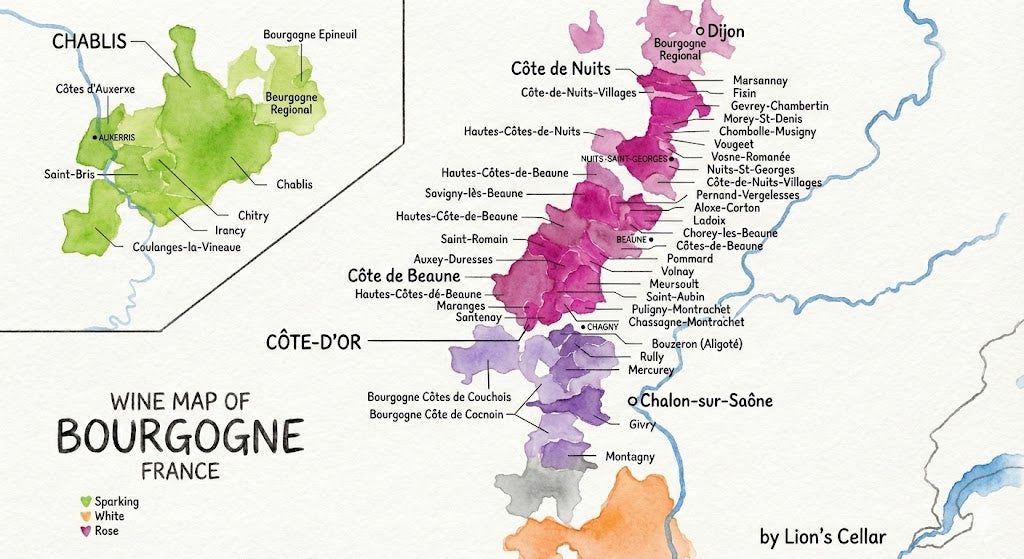
Burgundy sits in east-central France, about halfway between Paris and Lyon . It's broken into five main wine-growing zones that run in a line like stubbies in a fridge:
- Chablis – the northern outpost, closer to Champagne than the rest of Burgundy
- Côte de Nuits – the "night slope" where Pinot Noir goes for gold
- Côte de Beaune – the "slope of Beaune" where Chardonnay gets fancy
- Côte Chalonnaise – the value hunter's best mate
- Mâconnais – the warm, southern rellie who marches to its own drum
A Quick History Lesson (Don't Nod Off)
About 200 million years back, this whole joint was underwater . Now it's limestone soils packed with fossilized seashells – which is why your Chablis sometimes tastes like you've licked a wet rock (in a good way, I swear). The Romans rocked up around 1AD, but it was the Catholic monks in the Middle Ages who really got the party started, planting vines for the church and the aristocratic Dukes of Burgundy. After the French Revolution, the vineyards went to the people, and today these vignerons are more attached to their land than a koala to a eucalyptus tree, with organic and biodynamic farming going gangbusters .

Fossil in limestone. Photo by Paul Grand.
Chablis: The Cold-Hearted Chardonnay Specialist
Chablis is the isolated overachiever of the family – geographically closer to Champagne and copping weather that'd make a Tasmanian winter feel tropical . The Serein River runs through it, trying its best to moderate the climate, but spring frosts are still a bastard.
The soil is called Kimmeridgian limestone, same as Champagne's chalky stuff . It's brilliant at holding and reflecting heat – crucial when you're this far north – and gives the wines that signature purity and crispness. All wines here are white Chardonnay, lean as a greyhound and unoaked (mostly).
True story:Mate of mine once turned up to a BBQ with a $12 cleanskin Chardonnay, claiming it was "Australian Chablis." The host – a wine wanker from way back – nearly choked on his craft sausage when he tasted it and admitted, "Actually, that's not half bad." Sometimes ignorance is bliss, eh?

Côte de Nuits: Where Pinot Noir Wears a Crown
This is the the spot for Pinot Noir, with 24 Grand Cru vineyards producing some of the most expensive grape juice on the planet . The Côte de Nuits runs south from Dijon to Corgoloin, with 80% Pinot Noir and the rest Chardonnay or rosé (Marsannay's specialty).
The Grand Cru vineyards cling to eastern slopes facing the Saône River valley in a patchwork that'd give a surveyor nightmares . Most are tiny and have more owners than a Sydney apartment block, thanks to France's post-revolution inheritance laws. These Pinots can age for decades – which is handy, because that's about how long you'll need to save up for them. Prices can easily hit thousands per bottle.

But here's the hot tip: Look for Côte de Nuits Village wines from Fixin, Brochon, Premeaux-Prissey, Comblanchien, and Corgoloin . Mostly Pinot Noir, these show classic full-bodied Burgundy notes of black currant, cherry, fresh red fruits, and that earthy mushroom and spice combo. The Premier Cru versions are grouse value for special occasions.
Côte de Beaune: Fancy Chardonnay's Home Turf
Named after the medieval village that's still the beating heart of Burgundy wine commerce, the Côte de Beaune does things a bit different . The valleys are more open and rolling, with southeasterly vineyard exposure, and Chardonnay gets top billing. Seven of the eight Grand Cru vineyards here pump out white wine – names like Corton, Corton-Charlemagne, and Montrachet (which literally means "Bald Mountain," probably named after some poor follically-challenged monk).

Buying tip that'll save you a packet:Hunt down Côte de Beaune Villages and Premier Cru wines from Chassagne-Montrachet, Santenay, Meursault, Puligny-Montrachet, Saint-Aubin, Volnay, Pommard, and Beaune . The whites are chockers with aromas of soft white flowers, dried grasses, fresh apple and pear, and sometimes a touch of hazelnut.
The reds are no slouches either – think plum, cherrystone, white tobacco, and that signature Burgundian earthy minerality with enough acidity to make your taste buds sit up and pay attention .
Pro tip: Côte de Nuits and Côte de Beaune together are called Côte d'Or – the "Golden Slope" . Historically considered the most important regions, it's like the MCG and SCG of the Burgundy cricket team.
Côte Chalonnaise: The Smart Punter's Secret
This is where the value hunters clean up . The Côte Chalonnaise sits between Chagny and Saint-Vallerin, and here's the kicker – no Grand Cru vineyards. The Dukes of Burgundy kept their posh holdings close to Dijon and wrote this area off as peasant territory. Their loss, our gain!

Bouzeron is the only appellation devoted to Aligoté, Burgundy's other white grape . Perfect summer sipper – floral, citrusy, flinty, with a touch of honey. Great with fish and chips by the beach.
Rully is the Crémant de Bourgogne capital, pumping out sparkling wines using the Champagne method since the 19th century . Quality bubbles without the Champagne price tag – ripper for weddings when you've got 150 rellies to liquor up.

A brisk day in Côte Chalonnaise. Painted by Nano Banana
The villages of Mercurey, Givry, and Montagny sit on Jurassic limestone and marl soils that'd make a geologist weep with joy . Givry alone has over 13 soil types, giving the wines serious individual character. Some families have held these vineyards since the 17th century – talk about long-term leases!
The wines here are bonza value: smooth Chardonnays with subtle oak and ripe tree fruits, and rustic Pinots packed with dried strawberry, cherry, earth, forest floor, and suede-like tannins . This is your "Tuesday night wine" territory – quality drops that won't have you eating two-minute noodles till payday.
Mâconnais: The Rogue Cousin
The Mâconnais is the largest and most southerly region, once considered "ordinary" but now the comeback king . During the 1920s depression and the wars, many growers had to sell to co-ops just to survive. By the '60s and '70s, when wine consumption dropped, they lifted their game big time – setting fruit quality standards and making their own wines instead of flogging grapes.

Located between Tournus and Saint-Véran, it's at the crossroads of northern and southern France . The architecture gets more Mediterranean, harvest starts two weeks earlier than in Chablis, and the whole vibe is more laid-back – think Queensland versus Victoria.
Viré-Clessé in the centre became an official appellation in 1999, but they've been making outstanding wines for centuries . The warmer climate shows in well-structured Chardonnays with ripe stone fruits, honeysuckle, citrus peel, and wild herbs.
The main event is Pouilly-Fuissé, a stunning amphitheater of vineyards surrounded by the Roche de Solutré and Roche de Vergisson . Many vineyards border Beaujolais over the hills, with limestone soils mixed with a bit of granite. The Chardonnays here show soft apple, pineapple, and white peach aromas with brilliant structure and freshness.
Burgundy Classifications: Decoding the Label
Burgundy has over 100 appellations divided into four quality levels . Think of it like cricket grades:
- Grand Cru (1%): The test match players – top plots called *climats*. 33 Grand Crus in Côte d'Or, about 60% Pinot Noir. These are the wines you cellar for decades and crack open when your team wins the Ashes.
- Premier Cru (10%): The Sheffield Shield level – exceptional *climats* with 640 different plots. Still grouse quality without requiring a second mortgage.
- Village Wines (37%): Your grade cricket – named after the town, fresh and fruity with little oak. Ripper for a Sunday session.
- Regional Wines (52%): The backyard cricket of Burgundy – made from anywhere in the region, fresh and lively. Look for "Bourgogne Rouge" or "Bourgogne Blanc" on the label .

Regional Wines: Your Entry Ticket
These are made from grapes grown anywhere in Burgundy and tend to be fresh, light, and lively – perfect for aperitifs or when you're three wines deep at a BBQ and need something easy-drinking . Check the back label too – they're now allowed to note the grape variety, which helps when you're trying to remember what the hell you drank last night.
And don't forget **Crémant de Bourgogne** – quality bubbles that'll make your sparking wine-loving auntie very happy at Christmas .
Village Wines: Stepping It Up
Named after the towns near where the grapes are sourced, these are still fresh and fruity but a tad more complex . Look for names like Pouilly-Fuissé, Santenay, Givry, or Mercurey. It's like upgrading from a six-pack to a case – better value and more impressive at parties.
Premier Cru: The Sweet Spot
These come from special vineyard areas within a village called *climats* . The wines are more intense than regular Village wines, maybe because of the soil, sun exposure, longer oak aging, or the winemaker's secret handshake. Premier Crus are still affordable and make marvelous food wines. The label will say "Premier Cru" or "1er Cru" – look for that, and you'll look like you know your stuff.
Grand Cru: The Big Dogs
The crown jewels of Bourgogne – names like Romanée-Conti, La Tâche, Montrachet . They account for just over 1% of production but command top dollar. Bold, powerful, complex, and made for cellaring, they're the epitome of Pinot Noir and Chardonnay. Some Grand Cru vineyards are literally inches away from Premier Cru plots – talk about location, location, location!
Chablis: Doing Its Own Bloody Thing
Here's where Burgundy's rules go out the window . Chablis has its own ranking system because apparently, they reckon they're special (and fair enough, they kind of are):
- Petit Chablis: Grapes from around the village, higher acidity, light citrus character. Drink young while you're still young yourself
- Chablis: Rounder, more minerally, from the limestone slopes near the village. Most of what you'll find at your local bottle-o falls here.
- Premier Cru Chablis: Only 15% of production, from vineyards with Kimmeridgian limestone marl. Look for climat names like "Mont de Milieu," "Côte de Léchet," or "Fourchaume" on the label .
- Grand Cru Chablis: Seven climats inside one Grand Cru area north of town: Blanchot, Bougros, Les Clos, Grenouilles, Preuses, Valmur, and Vaudésir . These can taste different because many age in oak, developing floral honey notes and flinty acidity that ages beautifully.

Final word of advice: Burgundy's like a good mate – complex, sometimes bloody expensive, but worth getting to know. Start with the Village wines, work your way up, and remember: the best wine is the one you're sharing with friends, even if it didn't cost a fortune.
Cheers!
0 comments